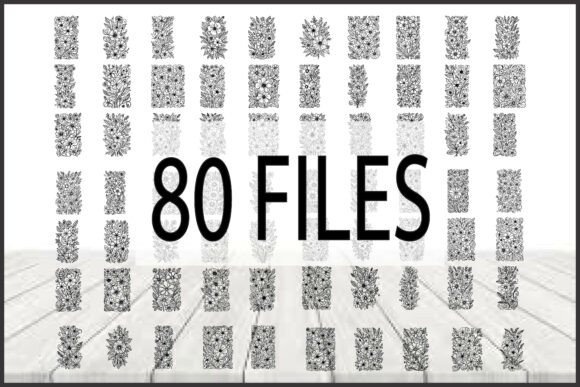
Vertical Floral Borders and Panels Line
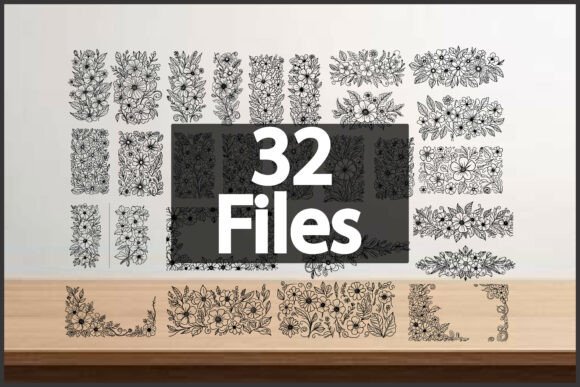
If you’ve ever spent hours searching for clean, scalable floral borders that actually work across multiple platforms—whether you’re designing a wedding invitation in Illustrator, cutting a delicate frame on your Cricut, or preparing a printable adult coloring page—you know how rare it is to find one set that performs well everywhere. The Vertical Floral Borders and Panels Line solves that problem not with compromise, but with precision: 80 hand-crafted, black-and-white line art floral motifs—each optimized as vertical borders, panels, or bookmark frames—and delivered in six fully editable formats.
Why vertical floral design matters more than you think
Most floral clip art leans horizontal: banners, wreaths, corner accents. But vertical space—margins, sidebars, book spines, greeting card edges, digital newsletter columns—is where subtle elegance lives. A well-proportioned vertical floral panel adds rhythm without crowding; it guides the eye down a page, frames text with botanical grace, or turns an ordinary PDF worksheet into something tactile and intentional. Unlike generic scrollwork or over-rendered bouquets, these illustrations are built as line art flowers: minimal, consistent stroke weight, no fills, no gradients—just confident outlines ready for color, cut, or print.
Real-world uses—not just “crafting” in theory
A freelance stationery designer used the Vertical Floral Borders and Panels Line to create a cohesive suite of bridal shower cards. Instead of redrawing a border for each card size, she scaled the SVG files seamlessly from 4×6 inches to 8×10 framed prints—all while preserving crisp edges at any resolution. An educator building printable mindfulness journals pulled four different floral bookmark designs to accompany weekly reflection prompts—each instantly recolorable in Canva using the included PNGs. And a small-batch POD seller testing botanical-themed planner inserts found the EPS and AI files indispensable for adjusting line thickness before sending to their print vendor.
Format versatility that actually delivers
The bundle includes 80 files in each of six formats: SVG, PNG, EPS, AI, JPG, and PDF. That’s not redundancy—it’s functional flexibility. SVG files load instantly into Cricut Design Space and Silhouette Studio with layers intact, ideal for precise cutting (think laser-cut wedding place cards or intricate scrapbook embellishments). AI and EPS files retain vector paths for professional editing in Adobe applications—adjust anchor points, change stroke profiles, or isolate individual blossoms. PNGs (with transparent backgrounds) drop cleanly into Canva, PowerPoint, or Google Docs for quick mockups. JPGs serve well for low-barrier sharing or email previews. And PDFs offer reliable, print-ready versions—especially useful when handing off to clients or local print shops unfamiliar with vector workflows.
What this means for your workflow
- No more format-hopping guesswork: Whether you're prepping a sticker sheet in Silhouette or building a Canva template for clients, you’re never stuck converting or risking pixelation.
- Consistent aesthetic across outputs: All 80 motifs share the same line weight, spacing logic, and botanical vocabulary—so your greeting cards, bookmarks, and coloring pages feel like parts of one thoughtful system, not a collage of mismatched assets.
- Time saved isn’t just minutes—it’s decision fatigue avoided. When you have 80 distinct vertical compositions (not 80 variations of one vine), you can match form to function: a tight, narrow side border for narrow-margin digital reports; a tall, branching page divider for two-column newsletters; a looping floral ribbon that wraps elegantly around a certificate or diploma.
Who benefits most—and why
This isn’t just for hobbyists. Small business owners launching a botanical-themed product line use these as foundational elements for packaging labels, social media templates, and Shopify banners—without licensing ambiguity. Educators creating differentiated learning materials rely on the clean line art for accessible coloring pages that support fine motor development and focus. Print-on-demand creators integrate the SVGs directly into automated workflows for custom journals and notebooks—no manual tracing needed. Even embroidery designers repurpose the outlines as stitch guides, scaling them precisely for hoop sizes without distortion.
That said, it’s worth noting: if you need full-color, photorealistic florals—or highly stylized, non-line-art interpretations—this bundle won’t fill that need. It’s intentionally monochrome, minimalist, and scalable. Likewise, while the 80 motifs cover diverse botanical forms (roses, jasmine, eucalyptus, climbing ivy, delicate sprigs), they aren’t exhaustive in species variety. Think of them as a refined toolkit—not an encyclopedia.
Practical tips for getting started
Start by identifying your most frequent vertical canvas: Is it a 6-inch-wide sidebar in your blog layout? A 12-inch-tall greeting card edge? A 3-inch-wide bookmark? Filter your initial selection by approximate height-to-width ratio—many of the panels are labeled descriptively (e.g., “Tall Wisteria Panel,” “Narrow Peony Side Border”) to speed up matching. For Cricut users, open the SVGs first—check layer names and grouping; ungroup if needed to adjust spacing between stems. In Illustrator, try using the Width Tool to subtly widen strokes on larger-format prints for visual impact without losing delicacy.
And if you’re curating for adult coloring pages: test contrast early. These line art flowers were drawn with consistent 0.25–0.75 pt strokes—ideal for both fine-tip markers and broader colored pencils. But if printing on textured paper, consider outputting at 300 DPI and slightly increasing stroke width in your PDF export settings for clarity.
More than decoration—structure with intention
Good design doesn’t shout. It supports. The Vertical Floral Borders and Panels Line works because it respects the space it occupies—never overwhelming, always legible, consistently elegant. Whether you’re crafting a quiet moment in a coloring book, framing a heartfelt message on a condolence card, or adding quiet sophistication to a boutique’s packaging, these aren’t just graphics. They’re tools for intentionality: helping you communicate care, attention, and continuity—without saying a word.