Vintage Pineapple Doily Pattern
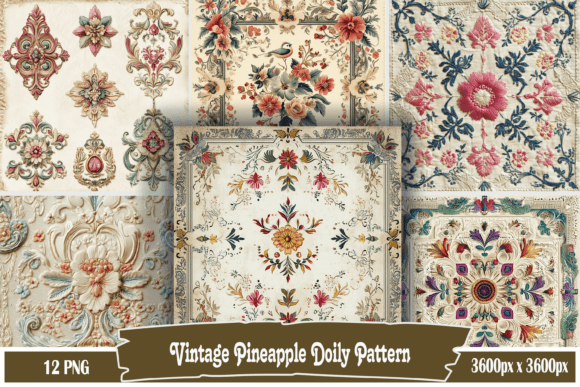
The Vintage Pineapple Doily Pattern is a digitally rendered, high-fidelity design inspired by traditional lace doilies featuring the pineapple motif—a symbol historically associated with hospitality, warmth, and craftsmanship. Unlike scanned or photographed physical doilies, this pattern is a clean, scalable digital asset created specifically for professional design use. Each file is delivered as a 12” × 12” (3600 px × 3600 px) PNG at 300 DPI, with a solid, non-transparent background and vibrant, consistent color reproduction.
People often seek out the Vintage Pineapple Doily Pattern when they need a decorative, period-evoking element that balances ornamental detail with visual clarity. It’s commonly used in contexts where texture, heritage aesthetics, or subtle visual rhythm enhance communication—such as branding for artisanal food products, wedding stationery, boutique packaging, or curated social media visuals. Its appeal lies not only in its visual character but also in its technical readiness: no additional editing is required to place it into print or digital layouts.
One key benefit of this pattern is its resolution and format consistency. At 300 DPI and 3600 px square, it supports high-quality printing on standard letter-sized paper, greeting cards, or fabric mockups without pixelation. The PNG format preserves sharp edges and saturated colors, while the solid background eliminates transparency-related layering complications in tools like Photoshop or Canva. File sizes range between 10–20 MB per design—larger than typical web graphics, but necessary to maintain fidelity across both screen and print outputs.
However, these strengths come with tradeoffs. The fixed 12” × 12” dimensions mean the pattern does not tile seamlessly unless manually adjusted. Users expecting repeatable, edge-to-edge wallpaper functionality will need to edit the image—either by duplicating and aligning copies or using specialized tiling tools. Additionally, because the background is solid rather than transparent, the pattern cannot be overlaid directly onto complex or gradient backgrounds without masking or blending adjustments. Designers working with variable or dynamic backdrops may find this limiting compared to vector-based or layered PSD alternatives.
Color fidelity is another consideration. While the designs are described as “vibrant and colorful,” actual appearance depends on monitor calibration and output device capabilities. Soft-proofing is recommended before final print production, especially for brand-critical projects where Pantone-matching or CMYK conversion is required. Also, because these are raster images—not editable vectors—the pattern cannot be recolored or modified in shape without raster editing software and some technical familiarity.
The Vintage Pineapple Doily Pattern is a strong fit for users who prioritize plug-and-play usability over flexibility. Photographers adding elegant borders to portrait prints, marketers designing seasonal email headers, or small-business owners creating Instagram story templates may find immediate value. Its vintage sensibility pairs well with rustic, tropical, or mid-century design themes—particularly where authenticity and tactile suggestion matter more than geometric precision.
Conversely, alternatives may be preferable in several scenarios. If seamless tiling is essential—for example, for website backgrounds, textile design, or large-format wall graphics—vector-based pineapple motifs or SVG patterns offer scalability and repetition without quality loss. For users needing full creative control over color, scale, or composition, editable AI or EPS files would allow non-destructive adjustments. Similarly, those integrating patterns into motion graphics or responsive web layouts may prefer lightweight WebP or CSS-generated patterns instead of large PNGs.
It’s also worth considering licensing scope. While the description implies personal and commercial use, readers should verify included usage rights—especially for client-facing work or product resale. Some digital asset providers restrict use in templates sold on marketplaces like Creative Market or Envato, or prohibit embedding in SaaS platforms without extended licenses.
Practical decision-making starts with clarifying your primary use case. Ask yourself: Will this be printed at high resolution? Is a fixed-size, single-layer asset sufficient—or do you need adaptability across formats and outputs? Do you have access to and comfort with raster editing tools, or do you rely on drag-and-drop platforms with limited layer controls? If your workflow emphasizes speed and consistency over customization, the Vintage Pineapple Doily Pattern delivers reliable results. If your projects demand frequent resizing, recoloring, or integration into multi-layer compositions, investing time in vector sources or learning basic tiling techniques may yield longer-term efficiency.
Another factor is audience alignment. The pineapple motif carries cultural associations—particularly in Southern U.S., Caribbean, and Victorian-era design traditions. While widely recognized as welcoming and cheerful, it may unintentionally signal specific regional or historical contexts. Evaluate whether that connotation supports your message or risks misalignment—for instance, in global B2B tech branding versus a local tropical café’s menu design.
In summary, the Vintage Pineapple Doily Pattern serves a distinct niche: high-resolution, ready-to-use decorative imagery rooted in traditional craft aesthetics. Its value emerges most clearly when technical constraints match project requirements—namely, static layouts, print-dominant output, and a preference for nostalgic, textured visual language. It is neither a universal solution nor a substitute for foundational design skills, but rather one well-calibrated tool among many. Choosing it thoughtfully—based on format needs, workflow compatibility, and aesthetic intent—helps ensure it enhances rather than complicates your creative process.