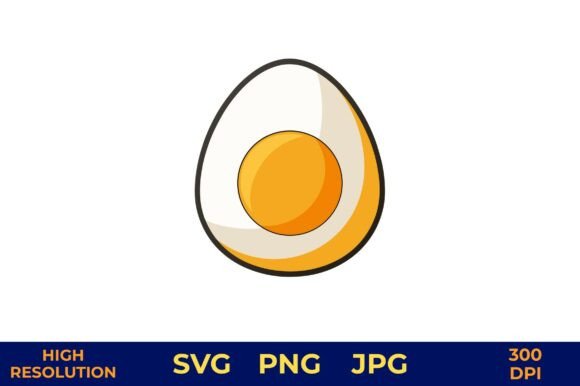
Single Egg with Vibrant Yolk Vector Art: A Practical Design Asset for Real-World Creative Workflows
A high-fidelity Single Egg with Vibrant Yolk Vector Art isn’t just a decorative element—it’s a precision-crafted digital asset built for integration. Its clean isolation, vibrant color fidelity, and technical readiness mean it moves seamlessly from concept to output without rework. Whether you’re designing a wedding menu at 10 p.m. or prepping branded merch for a small-batch product launch, this vector illustration delivers consistency where pixel drift, scaling distortion, or background cleanup would otherwise slow you down.
What It Is—and Why Technical Specifications Matter in Practice
This is a single, centered egg illustration featuring a rich, sunlit golden yolk against crisp white albumen—all rendered in vector (SVG) and raster (PNG, JPG) formats. The file set includes one 4200px × 4200px version at 300 dpi, with transparent backgrounds across all formats. That resolution isn’t arbitrary: it supports sharp printing on 12×12" photo paper, full-bleed posters, and high-resolution product mockups—without upscaling artifacts. The SVG ensures infinite scalability for web banners, app UIs, or laser-cut templates. And the transparency means no manual masking in Canva, Photoshop, or Figma—just drag, resize, and commit.
Because it’s delivered as a digital download—not a subscription, not a license-limited platform asset—you retain full usage rights. There’s no watermark, no attribution requirement, and no recurring fee. That changes how you plan: you can embed it into brand guidelines, include it in client deliverables, or reuse it across seasonal campaigns without renegotiating terms or checking licensing fine print.
Where It Fits Into Your Workflow—Before, During, and After
Before a project begins: Use the egg vector as a visual anchor during mood board assembly or brand alignment sessions. Its warm, organic tone pairs naturally with earthy palettes, minimalist typography, or rustic textures—making it useful for florists building seasonal collections or educators designing nature-themed lesson kits. Because it’s pre-optimized, you skip the “find-and-fix” loop of sourcing low-res images or converting messy PNGs.
During active creation: Drop the SVG directly into Illustrator for custom lettering integration, or import the PNG into Canva for social media carousels. Photographers use it as a subtle watermark overlay on food or lifestyle galleries; planners embed it into weekly habit trackers for visual motivation; wedding coordinators layer it onto seating charts or table numbers without worrying about bleed or resolution loss. Its consistent proportions and centered composition mean it aligns predictably with grids—no trial-and-error positioning.
After final delivery: Reuse becomes frictionless. That same egg graphic that appeared on a Save the Date card can scale cleanly to a 16×20" framed poster for a bridal shower backdrop—or shrink without blur onto a 2" sticker for favor tags. Because all files are delivered at once, version control is simple: no hunting through cloud folders for “final-final-v3-transparent.png.” You know exactly which asset to reach for.
Integration With Tools You Already Use
This vector art works natively with industry-standard tools—but its real strength lies in how it reduces context switching. In Adobe Creative Cloud, open the SVG in Illustrator to recolor the yolk or adjust stroke weight for custom line art. In Affinity Designer, place it as a linked asset so updates propagate across documents. In Figma, import the PNG and use constraints to pin it responsively inside frames—ideal for digital invitation prototypes.
For non-designers: Upload the JPG to Vistaprint or Printful to preview instantly on mugs, pillows, or tote bags. Drag the PNG into Google Slides for workshop handouts. Paste the SVG code directly into HTML emails for lightweight, retina-ready visuals. No plugin, no converter, no intermediate step required.
Practical Implementation Tips for Consistent Results
- Color matching matters. The yolk’s golden tone is calibrated for CMYK and RGB output—test it alongside your brand palette using eyedropper tools before finalizing print jobs. If adapting for dark mode interfaces, invert the background but keep the yolk’s luminance intact for readability.
- Scale with intention. While the SVG scales infinitely, avoid extreme enlargement in raster-based editors (e.g., >500% in Photoshop) unless you’ve converted it to a smart object first. Stick to the native 4200px size for best results in print layouts.
- Organize for reuse. Save all three formats (SVG, PNG, JPG) in a clearly labeled folder named “Egg_Vibrant_Yolk_Assets” within your master design resources library. Add a README.txt noting permitted uses—especially helpful if sharing with contractors or team members.
- Batch apply across projects. Create a Figma or Illustrator template with preset layers for common applications: “Sticker_Bleed,” “Web_Social_1080x1080,” “Print_Menu_8.5x11_Margin.” Pre-load the egg vector there so it’s always one click away.
Use Cases That Reflect Real Needs—Not Just Stock Imagery Tropes
It’s easy to default to “food blog header” or “breakfast café menu”—but this egg vector serves deeper functional needs. A nutrition coach uses it to symbolize whole-food simplicity in client onboarding PDFs. A stationery designer applies subtle opacity and soft drop shadows to create elegant watercolor-style overlays for wedding programs. A science educator imports the SVG into an interactive anatomy diagram, labeling chalaza and air cell with anchored text boxes.
Photographers repurpose it as a consistent visual motif across portfolio websites—placing it beside “Available for Commission” banners or embedding it into contact form icons. Small-batch soap makers print it on kraft labels for “Farm-Fresh Egg Soap” lines, relying on the yolk’s saturation to hold true on uncoated stock. Even productivity tool creators use it as a gentle visual cue in habit-tracking apps: a golden yolk appears when users complete a “nourish yourself” daily goal.
Long-Term Usability and Quality Control
Because this is a static, well-documented asset—not AI-generated or procedurally altered—you can rely on visual continuity across years of use. Unlike generative assets that shift unpredictably between versions, this egg remains identical every time you open it. That stability supports brand longevity: if you launched a bakery in 2023 using this vector on packaging, the same file will still render correctly in 2027 on updated Shopify themes or new POS hardware.
There’s no dependency on external servers, API keys, or login credentials. No risk of the source disappearing from a marketplace or changing licensing terms mid-project. You own the file. You decide how, when, and where it appears—without intermediaries.
That autonomy translates directly to efficiency. When a last-minute request comes in—for example, “Can we add this to the baby shower invitations by tomorrow?”—you’re not starting from scratch. You’re opening a folder, dragging one file into your layout, adjusting spacing, and exporting. The work isn’t in finding the asset. It’s in applying it meaningfully—and that’s where your expertise lives.