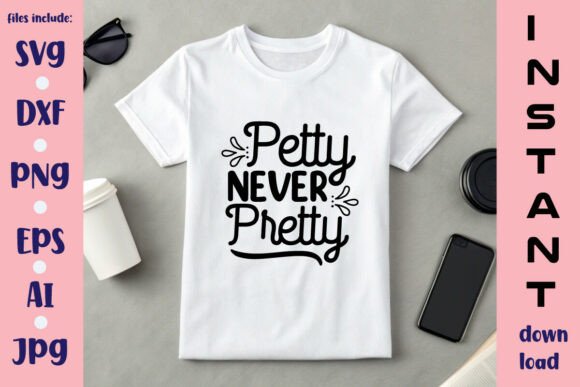
Petty Never Pretty SVG Design
If you've ever scrolled through a craft site, clicked “add to cart” on an SVG file, and then paused—wondering whether it’ll actually work for your Cricut project, your small-batch t-shirt line, or that sarcastic birthday card you’re making for your best friend—you’re not alone. The Petty Never Pretty SVG Design is one of those rare digital assets that lands right in the sweet spot between attitude and utility. It’s not just text in a font—it’s layered, scalable, machine-ready, and built to carry tone across materials, mediums, and moments.
What You’re Actually Getting (and Why It Matters)
This isn’t a single-file download with vague promises. When you purchase the Petty Never Pretty SVG Design, you receive six distinct file formats—SVG, PNG, DXF, PDF, EPS, and AI—all packed into one ZIP folder. That means whether you're cutting vinyl on a Silhouette Cameo, importing into Canva for a social media graphic, prepping a stencil for a chalkboard sign, or opening in Adobe Illustrator for print-ready layout work—you’ve got the right version ready to go.
No physical item ships. No waiting for delivery. Just immediate access to files designed to behave predictably across platforms and devices. And yes—you’ll need unzipping software like WinZip or WinRAR installed. It’s a tiny step, but skipping it means your files stay locked away. Think of it like having a key but forgetting where you left the door.
Where This Design Fits Into Real Life (Not Just Craft Blogs)
Let’s talk about where Petty Never Pretty SVG Design shows up—not in theory, but in action.
- A small-batch apparel seller uses the SVG to cut iron-on vinyl for limited-run tees sold at local markets. The bold, slightly off-kilter lettering reads clearly even at 8 inches wide—and because it’s vector-based, scaling up for a hoodie or down for a tote bag tag introduces zero pixelation or distortion.
- A middle school art teacher pulls the PDF version into a lesson on typography and tone. Students compare how “Petty Never Pretty” visually communicates sarcasm versus sincerity—then remix the design using free tools like Inkscape to explore contrast, spacing, and hierarchy.
- A wedding planner drops the PNG into a digital invitation suite, overlays it on a blush-and-charcoal background, and exports as a high-res JPG for email invites. Later, she cuts the SVG version from gold foil vinyl to create custom table numbers that guests snap photos of—and tag her business in.
- A content creator filming a “day in my studio” reel uses the DXF file to cut a freestanding acrylic sign for their shelf backdrop. It’s lightweight, camera-friendly, and adds personality without cluttering the frame.
Why Format Variety Isn’t Just a Checkbox
Having SVG, PNG, DXF, PDF, EPS, and AI files isn’t about padding a product description. Each format solves a real bottleneck:
- SVG is your go-to for cutting machines—Cricut Design Space, Silhouette Studio, and Brother ScanNCut all read it natively. It retains layers, grouping, and transparency so you can easily isolate letters or adjust spacing before cutting.
- PNG gives you crisp, transparent-background imagery perfect for digital use: blog headers, Instagram story stickers, printable quote cards, or mockups in Placeit or Smartmockups.
- DXF bridges the gap for users who prefer older software or need compatibility with CAD-based tools—especially helpful if you're collaborating with a sign shop or laser cutter operator.
- PDF and EPS are print-safe standards. Need to hand off to a local print shop? They’ll accept these without asking for “the native file.”
- AI (Adobe Illustrator) lets designers tweak anchor points, apply gradients, or integrate the phrase into larger branding systems—ideal for freelancers building cohesive client kits.
Realistic Things to Consider Before You Download
Before you click “purchase,” ask yourself a few practical questions:
- Do you know how to unzip files? If not, it takes two minutes to install WinRAR or 7-Zip (both free). Don’t assume your device will auto-open ZIPs—especially on newer Macs or Chromebooks.
- Are you using compatible software? Cricut Design Space accepts SVG and PNG. Silhouette Studio Standard supports SVG; Designer Edition adds DXF and PDF. Brother ScanNCut requires SVG or FCM—so double-check your model’s supported formats before assuming everything will load.
- Is this phrase right for your audience—or your brand voice? “Petty Never Pretty” leans playful-sarcastic. It works brilliantly for a sassy coffee mug line or a podcast merch drop—but may miss the mark for a corporate wellness workshop or a nonprofit fundraising campaign. Tone matters, especially when it’s baked into the design itself.
- Do you need commercial rights? Most sellers include personal *and* small commercial use (up to 500 physical items), but always verify the license terms. If you plan to sell thousands of units or embed it into a digital product (like a Canva template pack), confirm usage scope upfront.
How It Shows Up in Everyday Creative Workflows
You don’t need to be a professional designer to get value from Petty Never Pretty SVG Design. A busy parent uses the PNG to label snack bins in their kid’s lunchbox. A blogger inserts the SVG into a Procreate canvas to mock up a new Instagram highlight cover. A church volunteer cuts the phrase from black cardstock to make bulletin board lettering that matches their “Grace Over Grumbling” sermon series.
It’s also useful for testing ideas quickly. Want to see how “Petty Never Pretty” looks on a navy shirt vs. a cream tote? Load the SVG into your cutting software, change the fill color, and preview before committing to material. No sketching. No guessing. Just fast, low-risk iteration.
Final Thought: It’s Not Just About the Words—It’s About the Flexibility
The phrase “Petty Never Pretty” carries weight—but what makes this SVG design genuinely useful is how easily it moves between contexts. It doesn’t demand special training or expensive tools. It doesn’t lock you into one platform or output method. Whether you're designing for screen, surface, or stitch, it adapts. That kind of quiet versatility—paired with clear licensing, cross-machine compatibility, and thoughtful file formatting—is what turns a simple download into a reliable part of your creative toolkit.