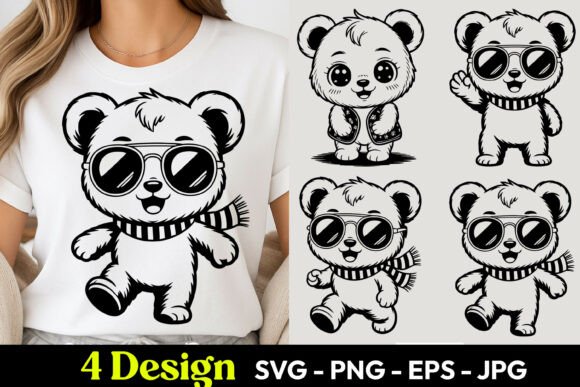
Cool Panda Sunglasses SVG PNG: Smart Digital Assets for Creators and Small Businesses
If you're designing merch, crafting social media visuals, prepping print-on-demand products, or building a playful brand identity, Cool Panda Sunglasses SVG PNG files offer instant visual appeal—paired with real-world flexibility. These aren’t just cute graphics; they’re production-ready digital assets built for versatility across platforms and purposes. But like any tool, their value depends entirely on how well you understand what’s included—and what isn’t.
What You’re Actually Getting (and Why It Matters)
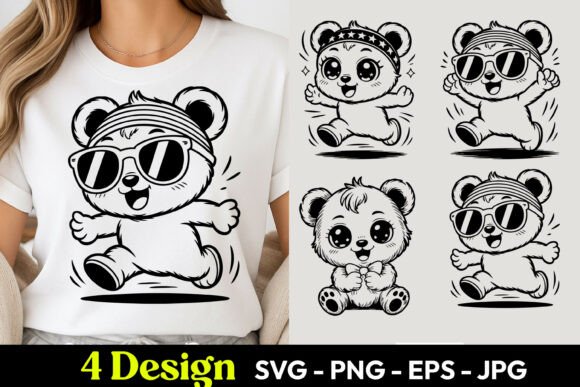
The Cool Panda Sunglasses SVG PNG bundle delivers four distinct file types in four variations each: 04 PNG files, 04 SVG files, 04 EPS files, and 04 JPG files. That’s 16 total files—all at 300 DPI print quality, optimized for both screen use and professional printing. Crucially, these are digital downloads only: no physical items ship. This means you get immediate access, full editing control (especially with SVG and EPS), and scalability without quality loss.
SVG files preserve vector integrity—ideal for resizing logos, cutting machines (Cricut, Silhouette), or web use. PNGs include transparent backgrounds, perfect for overlays, mockups, or layered designs. EPS supports legacy design software and large-format print workflows. JPGs serve quick sharing or email-friendly previews—but shouldn’t be used for scaling or precision work.
A Common Mistake: Assuming “More Files” Means “More Flexibility”
Some buyers assume having four of each format automatically guarantees seamless use across all tools. Not quite. For example, opening an EPS file in Canva or basic photo editors often fails—or strips layers and transparency. Similarly, using a JPG version for a t-shirt print may yield pixelation if scaled beyond its original dimensions, even if it’s labeled “300 DPI.” The DPI label only matters when the physical size matches the intended output. A 2-inch-wide JPG at 300 DPI becomes blurry if stretched to fit a 12-inch banner.
Better approach: Match the file type to your workflow—not just your software’s logo. Need to cut vinyl? Prioritize SVG or EPS. Building Instagram Stories? PNG with transparency saves time. Prepping a brochure layout in InDesign? EPS or high-res PNG works best. Always check your editor’s native support before assuming compatibility.
Overlooking Transparency and Backgrounds
One overlooked detail is background handling. While PNGs in this bundle include transparency, JPGs do not—and some users unknowingly place JPG versions over colored backgrounds, resulting in awkward white boxes around the panda sunglasses. That breaks visual cohesion, especially in branded content or product mockups.
Another subtle issue: SVG files sometimes render differently across browsers or older design apps if they contain embedded raster elements or unsupported filters. If your SVG looks crisp in Illustrator but appears jagged in a web preview, it may need simplification (e.g., converting effects to outlines) before final use.
Confusing “High Quality” With “Universal Readiness”
“High quality” is accurate—but it doesn’t mean plug-and-play in every context. For instance, a 300 DPI PNG is excellent for an 8×10” print—but if you’re ordering a 4×6’ trade show banner, even that resolution may fall short unless the original pixel dimensions are sufficiently large. Always verify the actual pixel width/height of PNG/JPG files before committing to large-scale output.
Similarly, SVG files scale infinitely in theory—but complex paths or excessive anchor points can slow down cutting machines or cause errors during import. If you’re using a Cricut and notice lag or failed cuts, try simplifying the SVG path in a vector editor first.
Why File Count Alone Doesn’t Reflect Value
Four of each format sounds generous—until you realize that identical designs across formats don’t increase creative options. What matters more is how each file is prepared: Are layers separated? Are colors set to CMYK for print or RGB for web? Are strokes expanded? Are fonts converted to outlines?
This bundle includes professionally prepared files—meaning text is outlined, strokes are consistent, and color modes are appropriate for their intended use. That saves hours of troubleshooting compared to free or low-cost alternatives where hidden inconsistencies cause last-minute fixes.
What to Check Before Downloading or Using
- Software compatibility: Confirm your design tool supports SVG (modern versions of Photoshop, Affinity Designer, Figma, Inkscape) or EPS (Illustrator, CorelDRAW, InDesign). Avoid relying solely on file extensions—test one file first.
- Intended use case: Are you printing? Cutting? Posting online? Each path favors different formats—and mixing them up adds unnecessary steps or compromises.
- Transparency needs: If your background isn’t white or solid, skip JPG entirely. Use PNG or SVG instead.
- Editing depth: SVG and EPS allow full path editing (change colors, reshape elements, isolate parts). PNG and JPG are flat—great for placement, not modification.
- Licensing clarity: These files are for personal and commercial use—no attribution required—but resale of unmodified files or use in digital templates for resale isn’t permitted. Always review the license terms included with your download.
Real-World Example: From Idea to Execution
Say you run a small eco-friendly apparel shop and want to launch a summer collection featuring playful panda motifs. You download Cool Panda Sunglasses SVG PNG, then:
- Use the SVG to cut bamboo-fiber fabric patches on your Silhouette Cameo—adjusting size without losing edge sharpness.
- Drop the PNG with transparency into a Shopify product mockup template—no white borders, clean integration.
- Import the EPS into your printer’s RIP software for consistent color matching on tote bags.
- Share the JPG version in a quick vendor email—lightweight, universally viewable, no font or layer concerns.
No reformatting. No guesswork. Just intentional use—because you understood what each file does best.
Final Thought: Clarity Over Convenience
Digital design thrives on intention—not assumptions. With Cool Panda Sunglasses SVG PNG, you’re not buying pixels or vectors alone. You’re investing in consistency, adaptability, and time saved. That value shows up when your t-shirt prints cleanly, your social post loads fast and looks polished, or your client presentation flows without technical hiccups.
So before you click “add to cart,” pause and ask: Which format matches my next step? Then use it—confidently, correctly, and creatively.
Thank You — Put it in your cart now. Don’t forget to follow up to stay updated with our offers.